How to Reduce Your Indian Accent for Clearer English Pronunciation

Many adults look for ways to make their English easier for others to understand, especially in fast-moving conversations at work or school. If you speak English with an Indian-influenced accent, you may find that certain vowels, consonants, or stress patterns occasionally lead to misunderstandings. India has a rich range of languages and dialects, and those natural speech patterns can influence how English sounds.
This guide explains how Indian language backgrounds shape English pronunciation and offers practical, respectful strategies to improve clarity. You’ll learn which sound patterns matter most for being understood and how small, intentional adjustments can make your communication feel smoother and more confident while still maintaining your cultural identity.
Key Takeaways
Indian-influenced English draws on many regional languages and dialects, so clarity work often begins by understanding how specific vowel sounds, consonant patterns, and stress patterns differ between your language background and American English.
Your regional accent and pronunciation habits can shift over time with intentional practice that matches your learning style. Accent training is about building flexibility and clarity, not erasing identity.
Listening to clear models of Standard American English helps you recognize the sound patterns, rhythm, and intonation that influence how your own English is understood.
Accent training is most effective when it focuses on the sounds that matter most for intelligibility, starting with individual words and gradually moving into real conversations, presentations, and everyday interactions.
How To Improve English Pronunciation With an Indian Accent
How Regional Languages Shape Indian-Influenced English
Accent Training Strategies for Indian English Accent Modification
How To Improve English Pronunciation With an Indian Accent

Understanding how to reduce your Indian accent begins with recognizing how your native language and regional background shape your English pronunciation.
Many speakers grow up using multiple Indian languages, and each one influences the natural rhythm they bring into daily communication. You can make progress when you understand which speech patterns affect clarity in American English and which features you want to adjust while still sounding like yourself.
Learning Vowel Sounds and Consonant Patterns
Depending on your regional language, you may rely on vowel or consonant patterns that differ from Standard American English. For example, many Indian languages use fewer vowel contrasts or different long-vowel distinctions, which can slightly shift how English syllables sound.
Some speakers also pronounce words with clearer, more deliberate consonants. This is influenced by languages such as Hindi, Tamil, Bengali, Telugu, Gujarati, Marathi, Malayalam, Punjabi, and others. These natural patterns can make English sound different from what American listeners expect.
Building comfort with American English vowels, voiced and voiceless consonants, and standard spelling-to-sound patterns helps improve clarity in conversations.
Understanding Syllable Stress and Sentence Stress
American English rhythm depends on alternating stressed and unstressed syllables. Many Indian languages have more evenly stressed syllables, which can shape how Indian English sounds.
Learning how English reduces certain vowels, stretches stressed syllables, and varies timing between words helps your speech align more closely with American English rhythm. These changes often make the biggest difference in overall intelligibility.
Adjusting Intonation Patterns for Clearer Communication
Intonation, the rise and fall of your pitch, signals meaning in English. Some Indian English speakers use rising intonation in statements, especially in fast speech. This can occasionally create confusion for listeners who expect a downward pitch at the end of a sentence.
Practicing steady downward intonation for statements, rising intonation for questions, and clear pitch movement in longer sentences helps your speech sound smoother and easier for American listeners to follow.
How Regional Languages Shape Indian-Influenced English

One of the strengths of Indian English is its reflection of the country’s rich linguistic diversity. India has hundreds of languages and dialects, and each language group brings its own pronunciation patterns into English.
These natural influences can shape how vowels, consonants, rhythm, and intonation sound when speaking American English.
Here are some examples of how language backgrounds may influence English pronunciation:
North Indian languages (such as Hindi, Punjabi, Urdu, Gujarati, and Marathi)
May produce clearer, more evenly stressed syllables
Often use retroflex consonants, which change the sound of /t/, /d/, or /r/ in English
Sometimes, it reduces long-vowel distinctions that American English listeners rely on
South Indian languages (such as Tamil, Telugu, Kannada, and Malayalam)
Often influences rhythm by placing equal weight on most syllables
May rely on vowel systems that don’t match American English vowel contrasts
It can influence how certain consonant clusters and aspiration are produced
Eastern and Northeastern languages (such as Bengali, Assamese, and Odia)
May shape English rhythm with smoother, more level intonation
Sometimes, the change how final consonants are pronounced or released
Can influence how English diphthongs sound in fast speech
These differences reflect the multilingual reality of Indian speakers. Understanding your own language background helps you identify which pronunciation patterns you want to keep and which you wish to adjust for clearer communication in American English settings.
Accent Training Strategies for Indian English Accent Modification
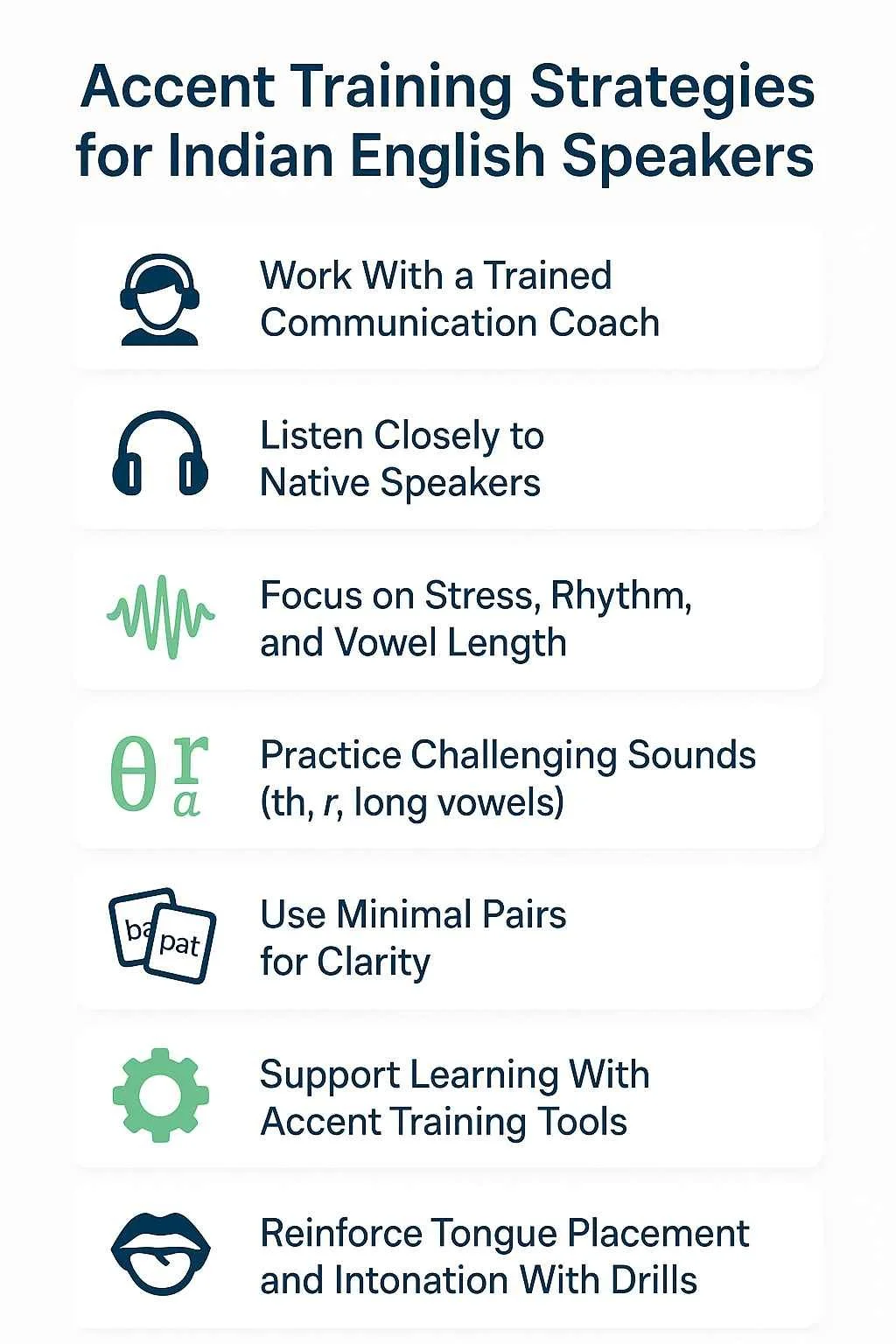
Accent training for Indian English speakers works best when you practice with a trained communication coach who understands both American English pronunciation and the many regional influences that shape Indian-influenced English. Personalized coaching helps you decide which features you want to adjust and which parts of your own voice you want to keep.
Listening Closely to Native English Speakers
Listening is a valuable way to understand how American accents and British English use stress, rhythm, and vowel length. These patterns can help you hear how spoken English differs from many Indian language backgrounds.
Paying attention to how native speakers reduce unstressed vowels or stretch stressed syllables helps you match the rhythm of the British or American accent you want to sound closer to.
Practicing Specific Sounds for Clearer English Pronunciation
Some English sounds can feel challenging because they may not exist or may work differently in many Indian languages. An accent trainer can help you identify which sounds are most important for clarity, such as th, r, long-vowel contrasts, or reduced vowels.
Practicing minimal pairs strengthens these distinctions and supports overall accent reduction without losing your identity.
Using Accent Training Tools to Support Coaching
Software tools can be helpful as supplements to guided work. A coach can show you how to use these tools effectively and avoid misinformation online.
Short drills and sound exercises can reinforce changes in tongue placement, airflow, and intonation, which are key skills for people who want their English to sound closer to an American accent or more neutral to listeners who are not familiar with foreign accents.

Private Online Accent Training
Check out our blog on private online accent training for more information.
Frequently Asked Questions About Accent Modification

1. How long does it take to reduce an Indian accent?
Reducing an Indian accent varies but takes months of consistent practice. The timeline depends on your pronunciation habits, the specific sounds you want to change, and how often you practice speaking. Some learners adjust common words quickly, while others need more time to adjust sentence stress. Daily practice helps your progress stay steady.
2. What makes the Indian accent sound different from that of native English speakers?
The Indian accent sounds different because Indian languages influence how speakers use vowels, consonants, stress, and rhythm in English. Many Indian languages use more evenly stressed syllables and different vowel systems, which naturally carry over into spoken English.
These patterns can change the overall flow, timing, and melody of English speech. These features are simply regional differences, not errors, and they can be adjusted through targeted practice if someone wants their English to sound clearer to American listeners.
3. Can I reduce my Indian accent while keeping parts of my own voice?
Yes, you can modify your Indian accent while keeping the parts of your voice that feel natural to you. Accent modification does not remove your identity; it only adjusts pronunciation habits that affect clarity.
You can choose which features to change based on your goals. Many learners retain slight Indian English features while still improving the intelligibility of their spoken English.
4. Why do some sounds, like th or r, feel hard to pronounce?
Some sounds feel difficult because they may not exist in a speaker’s first language or may be produced differently in Indian-influenced English. Many Indian languages use distinct tongue positions or sound placements, which naturally influence how th, r, and certain vowels come out in English.
Practicing minimal pairs helps speakers notice slight differences in tongue placement and airflow. With repetition, the new patterns become more familiar and automatic.
5. Do accent reduction classes work for Indian English speakers?
Accent modification training can help Indian English speakers improve clarity and confidence in spoken English. A trained accent coach or communication specialist can identify which sound patterns, stress habits, or intonation features may cause communication challenges for listeners.
Personalized training allows speakers to focus on the specific areas that matter most for intelligibility. Many learners find this type of one-on-one coaching helpful for job interviews, presentations, and workplace conversations.
How Connected Speech Pathology Can Help

Connected Speech Pathology provides one-on-one accent and communication coaching for those who want clearer spoken Standard American English. Our certified accent modification coaches understand how regional Indian languages shape pronunciation and work with each person to identify the specific features they want to adjust.
Accend modification sessions focus on practical skills such as vowel clarity, stress patterns, intonation, and overall speech rhythm. Feedback is personalized, easy to apply, and centered on helping speakers sound confident and authentic.
All sessions take place online, making it simple to meet from anywhere. With supportive guidance and targeted practice, Connected Speech Pathology helps speakers strengthen clarity while keeping the parts of their voice that feel natural.
Summary
Modifying your Indian accent becomes easier when you understand how Indian languages shape your English pronunciation. You can practice vowel sounds, stress patterns, and intonation changes that help your spoken English feel natural and clear.
Listening to native speakers and recording your voice helps you track your progress. With regular practice, your speech becomes easier for others to understand. Each step builds toward a sound that matches your communication goals.

About the Author
Allison Geller is a communication coach, speech-language pathologist, and founder of Connected Speech Pathology, an international online practice providing professional communication coaching and speech therapy for children, teens, and adults. With more than two decades of experience, she has worked in medical and educational settings, published research on aphasia, and leads a team of specialists helping clients improve skills in public speaking, vocal presence, accent clarity, articulation, language, fluency, and interpersonal communication.